


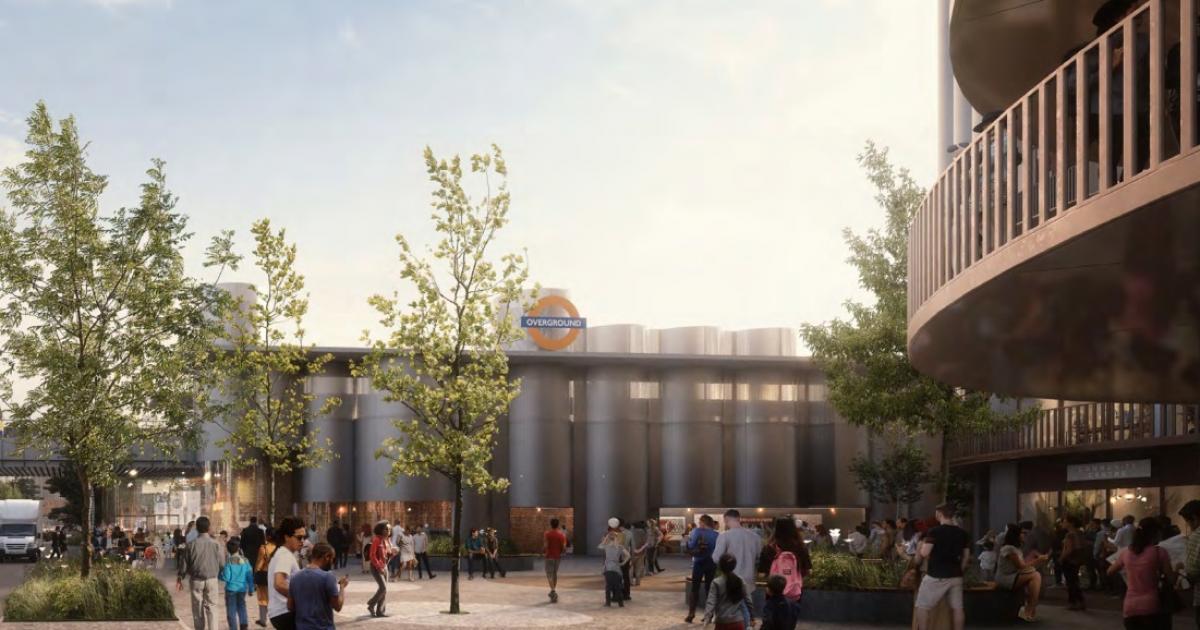
Proposals to build a new Overground Station at Surrey Canal have been in talks for over a decade, but recent discussions within the council have revealed it could be even closer to becoming a reality.
The new station would serve as part of the Windrush line between Queens Road Peckham and Surrey Quays.
At a meeting of the Mayor and Cabinet on September 10, councillors approved the use of Strategic Community Infrastructure Levy (SCIL) funding to help Transport for London (TfL) progress the next stage of work on the proposed Surrey Canal station.
The line would sit on the Windrush line between Queens Road Peckham and Surrey Quays.
The decision does not yet fully fund the construction of the station, but it does provide a crucial boost to enable detailed design work to move ahead, a step council officers and TfL say is essential to securing future government funding.
The station was initially proposed back in 2012, when the East London line was extended to Clapham Junction in the early 2010s.
At that time, TfL delivered “passive provision” for a future station, including a station box and platform foundations, but the station itself was never completed.
Later in 2018, TfL secured a grant from the government’s Housing Infrastructure Fund (HIF) for six projects along the Windrush line, including Surrey Canal.
However, rising costs and budget pressures led TfL to split the programme into two phases.
While phase one delivered upgrades such as step-free access at Surrey Quays station and power and signalling improvements to increase train frequency, Surrey Canal station was pushed into phase two and paused in 2021.
However in 2025, TfL has since remobilised the project, restarting early contractor involvement and carrying out updated surveys, design reviews and value engineering.
But a funding gap remains for the detailed design stage.
At a council meeting which took place on September 10, 2025, the Mayor and Cabinet members approved the use of SCIL – money collected from developers across the borough – to support the development of the station.
Authority was also given to the council’s Executive Director of Place to agree the exact allocation of funds and enter into the necessary legal arrangements with TfL.
Introducing the report, Councillor James-J Walsh described the station as a “significant infrastructure initiative” for Lewisham and the wider area, highlighting its role in tackling inequality, supporting sustainable transport and promoting the growth of housing.
Council papers outlined that sufficient SCIL funding is available for the proposed contribution and that no further council funding is being sought at present.
The proposed station is seen as critical to the delivery of the New Bermondsey masterplan, a major regeneration scheme north of the Winslade Estate.
Led by developer Renewal, the scheme would deliver around 3,500 new homes, including 1,000 designated as affordable, as well as commercial, community and leisure space.
A “Grampian condition” attached to the planning permission limits development beyond the first phase, around 600 homes, until Surrey Canal station is delivered, making progress on the station essential to unlocking the rest of the scheme.
Council officers say the station would also indirectly support the delivery of more than 4,000 additional homes across Lewisham and neighbouring Southwark.
Renewal has already committed £25 million towards the station, and the development is expected to generate significant Community Infrastructure Levy payments as the construction progresses in the future
Currently, the area around the site of the proposed station does not offer good public transport links, with a Public Transport Accessibility Level (PTAL) of between 1a and 2 in some locations.
Residents largely rely on buses or South Bermondsey national rail station, which has limited accessibility and facilities for those with mobility issues.
Surrey Canal station would therefore provide locals with a step-free accessible station from street to platform, improving access for those with mobility issues in the local area.
If a full funding package is secured, TfL has said it expects to outline a detailed design plan, with work to begin in early 2026 running until 2028, with construction expected to take over two years.