


Panoramas of Lost London features more than 300 photographs which evoke the bustling, changing city from 1870-1945 – from lavish wealthy homes to poverty ridden slums.
Hampstead Garden Suburb author and heritage expert Philip Davies has unearthed images of the shops, houses, streets and workplaces of Victorian and Edwardian London as it morphs into the modern city we know today.

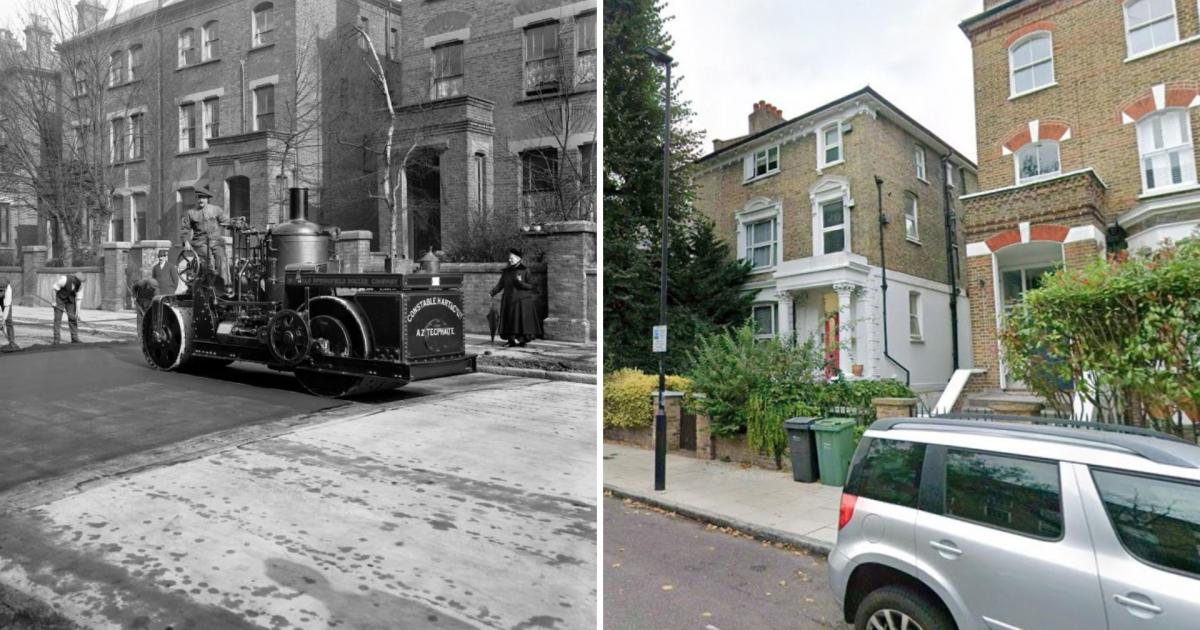
One image taken in Belsize Park in 1920 shows workmen using a Buffalo Springfield steam roller to resurface the street outside 78-82 Parkhill Road. It’s significant because asphalt would increasingly be used on roads as car use became more common.
Parkhill Road evolved from grand developments on the Belsize Estate in the 1850s and its large villas were built in Italianate style.
Just nine years after this photograph was taken, a famous resident moved into 11a.
Henry Moore lived and worked in the flat and studio from 1929 to 1940 while building his reputation as a sculptor.

His fellow sculptor Barbara Hepworth was a frequent visitor. She lived in the Mall studios behind Parkhill Road with the painter Ben Nicholson, and when the Dutch artist Piet Mondrian had work included in the Degenerate Art exhibition. staged by the Nazis in 1937 to highlight work they disapproved of, he became frightened enough to move from Paris to London at the age of 66.
With help from Nicholson, he set up a flat and studio at 60 Parkhill Road and apparently took to the wide streets of Belsize Park.
When a bomb damaged Henry Moore’s home, he and his wife Irina moved to rural Hertfordshire, where they lived for the rest of their lives. But the artist had already started to make his famous ‘Shelter Drawings’ of Londoners taking refuge from the Blitz in Belsize tube station.

They captured the popular imagination and Moore was asked to make further drawings as an official war artist.
Today it is protected as a Conservation area – and very desirable to wealthy property owners – actress Kate Winslet once owned a house there in the early noughties.
Many of the grand villas are now divided into flats but a six bed home on the street was recently sold by Goldschmidt and Howland with an asking price of just under £5 million.
Panoramas of Lost London: Work, Wealth, Poverty and Change 1870-1945 is published by Atlantic priced £40.