


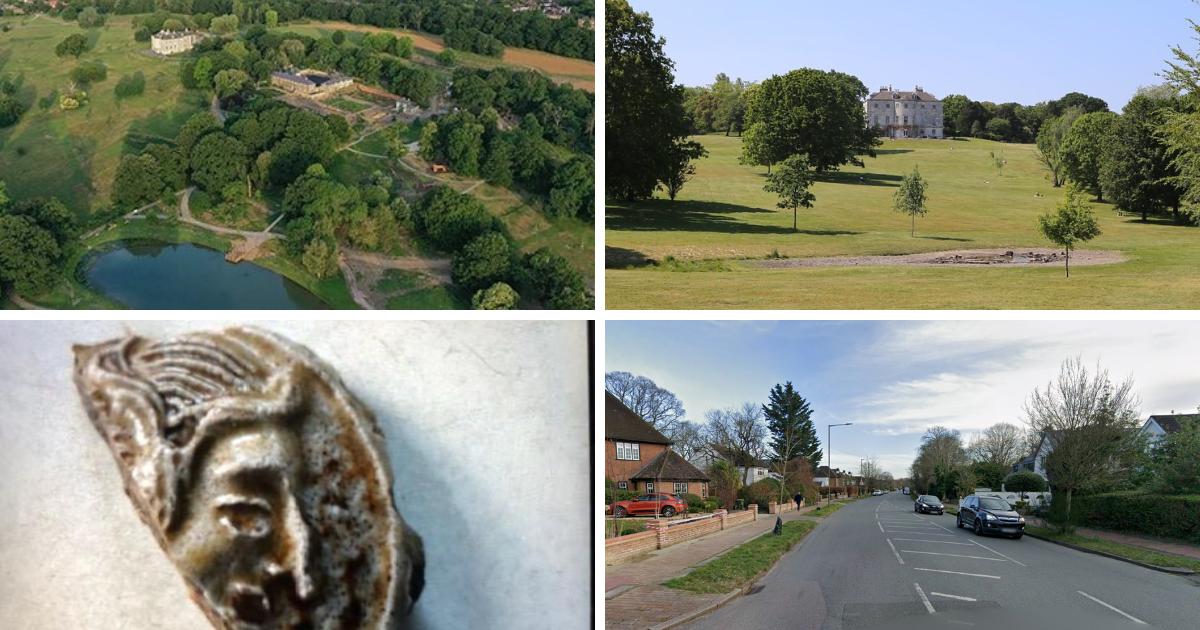
Beckenham is often thought of as a leafy suburb shaped by railways, parks and grand 18th-century houses.
But long before commuter lines and conservation areas, a far older route cut straight through the landscape – a Roman road that once connected London to the south coast and beyond.
A former Cambridge history student, ex-local councillor and professional landscape gardener for more than 40 years, Rod Reed previously spoke to News Shopper about its history, divulging some of Beckenham’s fascinating Roman past.
Over the years, Rod has worked closely with archaeologists, monitored local finds and acted as a conduit between residents, mudlarkers and councils when discoveries are made.

Today, much of the road is hidden beneath grass, modern streets and playing fields.
However, some parts of it still survive, and its influence can still be traced through Beckenham Place Park and the surrounding area.
But this Roman road, known to archaeologists as the London to Lewes Way, was no small road, forming part of a vital imperial network used by soldiers, traders, officials and messengers nearly 2,000 years ago.
The road once ran from Roman London, passing through what is now Southwark, crossed the Ravensbourne valley and continued through Beckenham, West Wickham, Edenbridge and the Sussex Weald, eventually reaching Lewes in Sussex.
For centuries, it was one of the major roads linking the capital to iron-producing regions and ports along the south coast.

But long after the Romans left Britain, the road continued to shape movement through the area, with historians believing it continued to be used throughout the Medieval period.
It’s believed that Simon de Montfort’s army travelled along it in the 13th century on the way to the Battle of Lewes.
Today traces of the road can still be identified in parts of London and Kent.
If you visit West Wickham, the line of the Roman road can be seen across the playing fields at the bottom of Corkscrew Hill.
Wickham Way, which closely follows the Roman path and takes its name from an Old English word derived from a Romano-British settlement.

Archaeological evidence suggests that West Wickham would have once been a town of around 6,000 people, which thrived so strongly because of its proximity to the road.
Every few miles along this route, significant Roman sites have been uncovered, ranging from villas and bathhouses to farmsteads and field systems.
At Hayes, archaeologists have found evidence of a Roman bathhouse and a coin hoard, and a Roman-British farmstead was also found at Bromley Common in previous years.
Beckenham Place Park also has a strong connection to the road, which sits beside the River Ravensbourne and would have been part of the road network historically.
Previously, mud larkers have found a number of Roman artefacts in the park, which suggests more could be lying under its greenery, from a Roman ridge tile found near the park’s lake to Roman coins being found in the area.

Rod argues that these finds suggest evidence of a villa or bathhouse in the area in close proximity to the road.
Yet despite the importance of the road and its links to south east London, it receives little acknowledgement locally.
Roman roads were not just for marching armies, they also helped to transport goods and build communities, which fundamentally changed the history of Britain.