


Leftovers from a side of salmon would have been perfect for rillettes, especially with the addition of a little smoked salmon; note the past conditional. I have cooked many large centre pieces for the celebratory table. Apart from the majestic birds mentioned, a haunch of wild boar, a suckling pig, a whole milk-fed lamb are amongst the dishes that have featured on our table over the years.

In the last few years however our birds have become smaller and smaller, a pheasant one year, then a mallard, a brace of partridge; I expect it will be a pair of quail next.
What, then, have we been enjoying chez Bissell over the last few weeks? Citrus fruit from southern Europe came early this season. It was a heart-warming sight to see boxes of Seville oranges in Pomona before Christmas, which means it is marmalade time again.

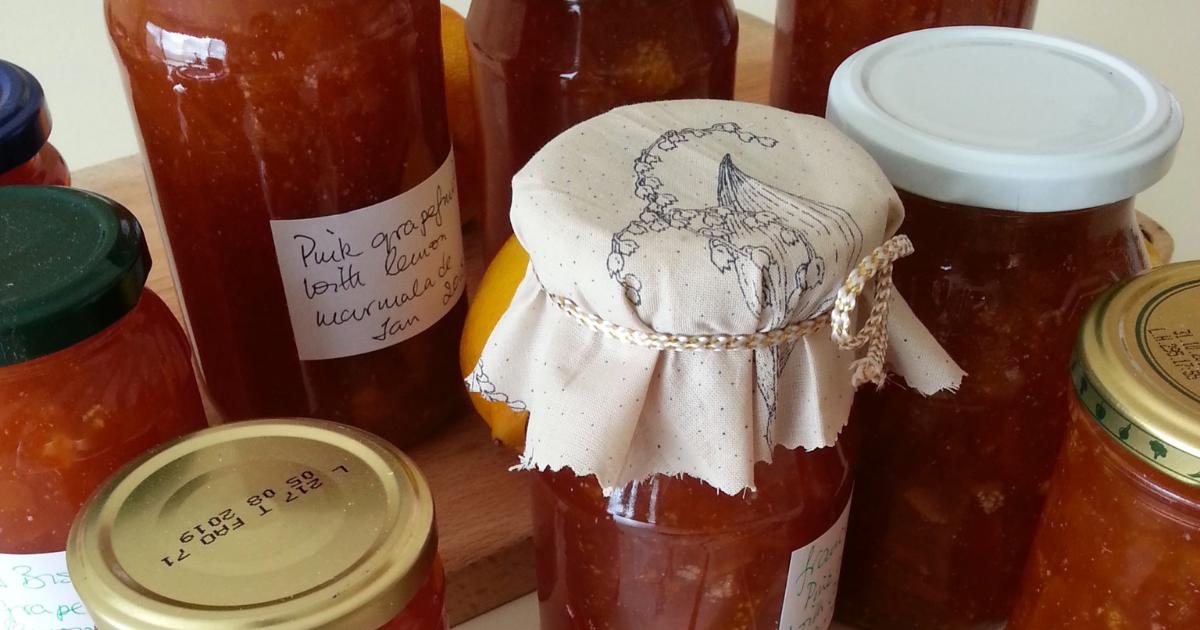
I never manage to make enough Seville marmalade to last the year, and find myself making grapefruit marmalade in the autumn. This has become our favourite now, whatever the time of year; the peel is thick and full of flavour, cooking to a lovely crescent of translucency. Surprisingly, the peel can be sliced thinly when cooked, so no need for a chunky marmalade.
Citrus fruit has enhanced my fish salads, not lemon or lime, but mandarins. In segments for cold salads, and for salade tiède, I halve and char the fruit on the griddle. Hot-smoked salmon and trout, mackerel and sardines are perfect partners for a spritz of mandarin or Seville orange juice.

A strip of Seville zest rubbed on the rim then dropped into a glass of iced crisp dry vermouth makes an excellent apéritif, and a slice will dress up a gin and tonic no end.
Another seasonal companion to seafood and other fish salads is persimmon, a glowing orange treasure which reaches us from Spain in abundance for a short winter season. Thinly sliced, the bright fruit acts as the perfect foil for poached cod in aioli. I also serve it with jamon serrano or Parma ham, sometimes with burrata.
For me the most rewarding of the winter produce is fennel and celeriac. At this time of year, we find the large, plump, satiny white fennel from Italy and Spain. It makes the perfect slaw or simple pickle.
If I want to serve it as an accompaniment to cold cuts or include it in a salad, I slice it thinly, put it in a bowl with a little sea salt, half a teaspoon or so, an even smaller amount of sugar, than a good splash of a mild vinegar; cider or moscatel work very well. Stir it around and leave for an hour or so before serving. It makes a particularly good accompaniment to fish salads. I do the same with celery, thinly slicing it on the diagonal to get a larger surface area.

Both vegetables are infinitely better in winter, after a touch of frost. I have never understood the attraction of the piles of stalky, stringy fennel one finds in farmers markets in the summet months. Of course, perhaps everyone is making pasta con le sarde, the Sicilian dish of pasta, sardines and fennel tops, for which this type of fennel is perfect.
One vegetable you are almost certain to meet in a farmers market near you at the moment is celeriac. Large, weighty, knobbly and invariably mucky, it more than repays the effort needed to bring it to the table. Brush off as much soil as you can, then using a very sharp and heavy knife, or cleaver, cut off the root parts and then chop the celeriac into quarters to make it easier to peel.
Once the skin has been removed, drop the quarters into lightly acidulated water to prevent the creamy flesh from browning until you are ready to use it.
For an unusual lasagna, thinly slice and blanch the celeriac, then assemble in place of pasta, with your usual filling and bechamel.
For an accompaniment to a braise or slow-cooked beef dish, cut the celeriac into wedges, season and roast in the oven. I also cooked fennel this way the other day and it was perfect with a boeuf bourguignon.
But my favourite preparation for celeriac is rémoulade, in a creamy, mustard-hinted mayonnaise. Here the thinly sliced celeriac is cut into matchsticks; again, more knife work, but it gives a better result than the shredder attachment on the Magimix.
I serve this with smoked, cured or pickled fish. Or, when I make moules marinières, I cook enough mussels for next day, when I mix them into a bowl of rémoulade for a sublime first.

Céleri rémoulade:
1 celeriac – prepared as described above
Mayonnaise- see recipe – freshly made, or good quality commercial ( I use Aldi’s Bramwell brand)
Dijon mustard-see recipe
Bring a saucepan of lightly salted water to the boil. Drop in the matchsticks of celeriac. Bring the water rapidly back to the boil, then immediately remove from the heat, tip the celeriac quickly into a sieve over the sink then rinse with very cold water.
Another way to blanch is to put into a sieve and pour boiling water through it. This method works well if you are using a smaller quantity of celeriac.
Drain the celeriac thoroughly, and roughly dry it.
In a bowl mix the celeriac with sufficient mayonnaise to coat it generously, adding as much or as little Dijon mustard as you like.
Marmalade:
A method rather than a recipe, you can adapt this to your preferred citrus fruit. I find lime the least successful because the skin is too thin. Grapefruit, pomelo, Seville oranges and thick-skinned lemons work best. The only other ingredient you need is sugar – granulated or jam sugar. The fruit has enough pectin not to require the added pectin in preserving sugar.
The key is to cook the fruit until the skin is very soft, enabling it to absorb all the sugar.
If cooking the fruit whole, place in a large saucepan, cover with water, bring to the boil and simmer until the peel is easily pierced, with no resistance.
Put a sieve over a large jug, and one by one, gently break open the fruit scoop out the pulp and let it run through the sieve. Once you have ‘emptied’ all the fruit, slice the peel as finely as you wish.
Weight it, together with the juices dripped from the pulp, and whatever is left of the cooking water. For every 500 g, add 500 g sugar.
Transfer both to a large saucepan and heat gently until the sugar has dissolved. Then boil on a high heat until setting point is reached, 110 C with a sugar thermometer. Or start testing for a set after 10 to 15 minutes by dropping a little marmalade onto a cold saucer.
Once the mixture is ready to set, pot the marmalade in clean, hot jars, with clean, well-fitting lids or cellophane covers.
I heat my jars in the dishwasher or in the oven at 115 C.
Once sealed and cooled, label the jars, including the date.
Cook’s note:
A dash of malt whisky can be added to the pan just before the marmalade is ready for potting. Other flavourings can be added, cardamom, vanilla, tonka bean, lemon grass, lime leaves or bay as the fancy takes you.