


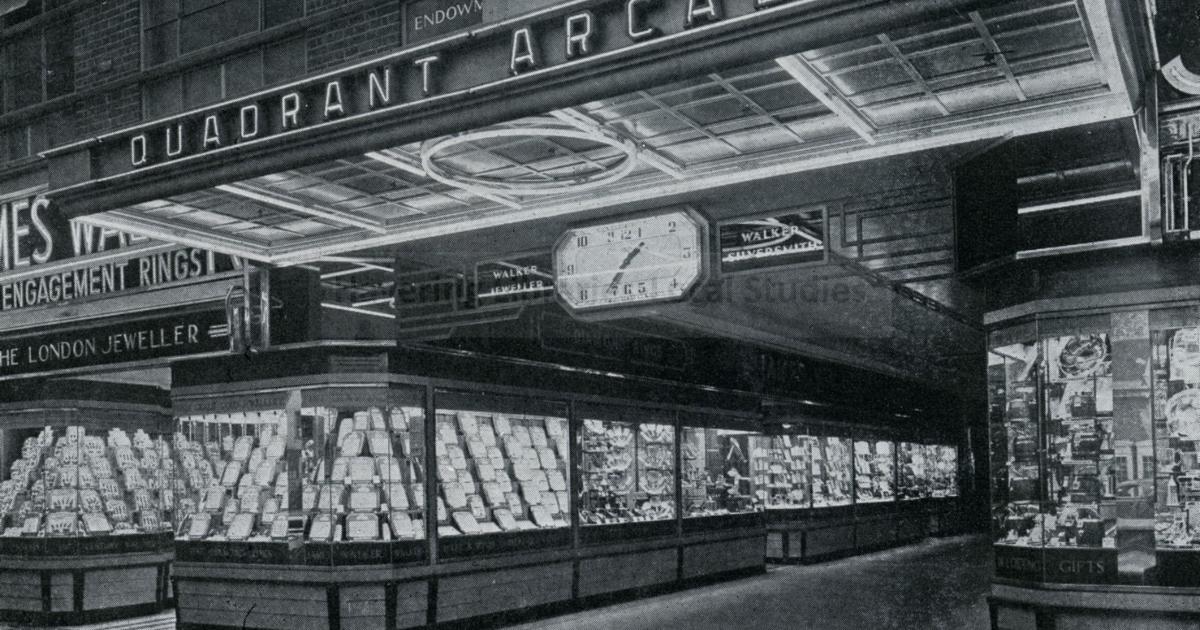
We are taking a moment to shine a spotlight on the town’s Quadrant Arcade, which is still open more than 90 years later and occupied by independent businesses to this day.
Quadrant Arcade welcomed customers to its halls for the first time on September 23, 1935.

According to Havering Libraries, prior to its ongoing use as a the Quadrant Arcade the building was used as the court house of the Liberty of Havering and before that as a jail and police station.
In 1935, there were around 45 shops and one large store that made up the covered shopping arcade, including Dolcis Shoes and Jax of Oxford Street on the South Street entrance, and jewellers James Walker occupying the Market Place entrance.
Local businessman William Goodchild was behind the founding of the arcade, starting work on the Dolcis store in February 1934.

Quadrant Arcade is understood to have provided many jobs to the local community, both in the construction of shops and their staffing once completed, during a time of severe unemployment.
Havering Libraries reports that by November 1939, there were a recorded 162 people working within its halls.
The shopping centre suffered damage during the Second World War, but escaped any direct hits.

It is understood that the worst of this damage was suffered on December 8, 1940, when a bomb hit nearby at the Romford Telephone Exchange and Brewery in South Street.
After the war, William Goodchild resumed promoting the Quadrant Arcade.
A brochure was designed in 1939 but not published until five years after the war as a result of paper shortages.

The brochure, archived by Havering Libraries, included a list of tenants for 1950 and photographs ranging from between 1935 and 1949.
Tenants included London Co-Operative Society, Dunn’s Footwear Ltd, and British Home Stores among many others.