


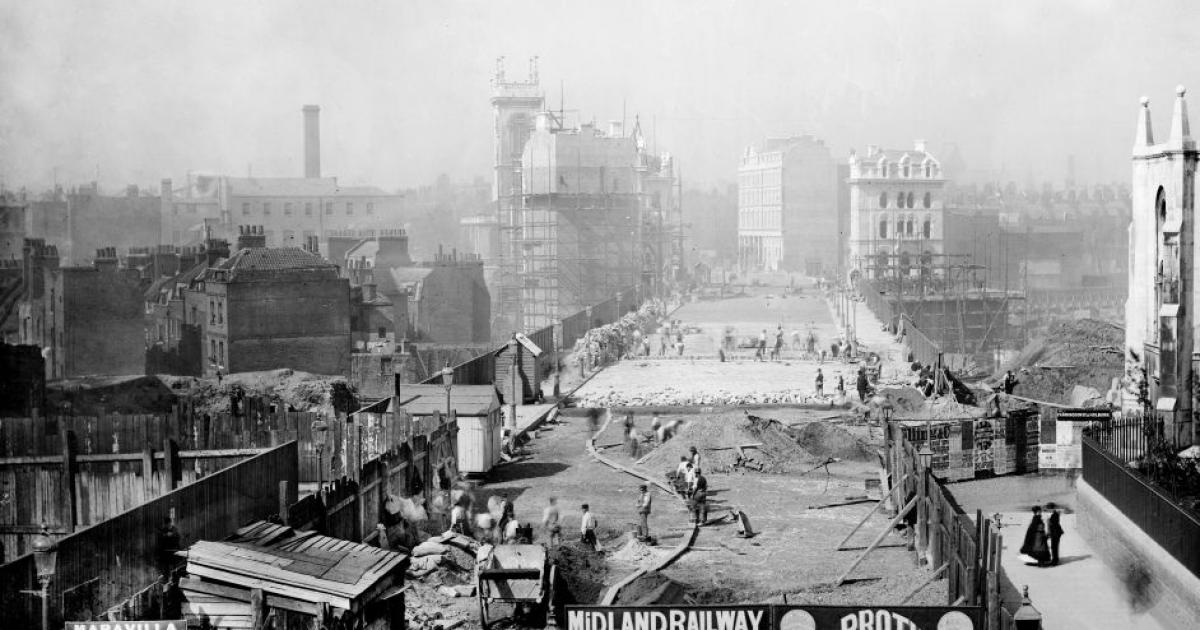
Holborn Viaduct was built in the 1860s to improve the route between the West End and City of London – making it London’s first flyover.
A fascinating photograph from a new book Panoramas of Lost London shows the road under construction in 1868 – a hoarding in the foreground advertises the new St Pancras Station just opened by the Midland Railway.

Linking Holborn Circus with Newgate Street, it is 430 metres long and 80 metres wide, and spans not only Farringdon Street but the subterranean River Fleet.
In fact it was to avoid carriages having to descend to the river valley and back up again that the overhead road was built.
When it opened in 1869, none other than Queen Victoria herself turned out to mark the occasion, in a carriage procession that also took in the new Blackfriars Bridge and Queen Victoria Street.
Her coach reportedly stopped beneath the structure so she could admire decorative details, which included parapets decorated with figures representing commerce, agriculture, science and fine art.

The viaduct had cost £2.5 million and would ease congestion in the growing city. Pedestrian access from the viaduct down to Farringdon Street was via staircases inside four beautiful pavilions, at each side and end.
Each pavilion features a famous London figure Sir Hugh Myddelton (1560-1631) who led the construction of the New River, bringing fresh water into London, Sir Thomas Gresham (1519-1579) who founded the Royal Exchange, Sir William Walworth (1322-1385), Mayor of London, and Henry Fitz Ailwin (1135-1212), the first ever Mayor of London.
In 1941, German bombing raids damaged most of the area including the north side pavilions. They were later copied and reinstated with lifts put in.
There was once a Holborn Viaduct railway station, which opened in 1874 and has now been replaced by City Thameslink.
In January 1882, Thomas Edison opened the world’s first coal-fired power station at number 57 Holborn Viaduct.
Known as The Edison Electric Light Station, it’s coal-powered steam engine lit a thousand lamps from Holborn Circus to St Martin le Grand.
It ran at a loss and closed in 1886 – but Edison would take his concept to New York where it would conquer the world.
Panoramas of Lost London: Work, Wealth, Poverty and Change 1870-1945 by Hampstead Garden Suburb heritage expert Philip Davies features over 300 black and white photographs of people, places and buildings opening a window onto a vanished past.
It is published by Atlantic price £40.