


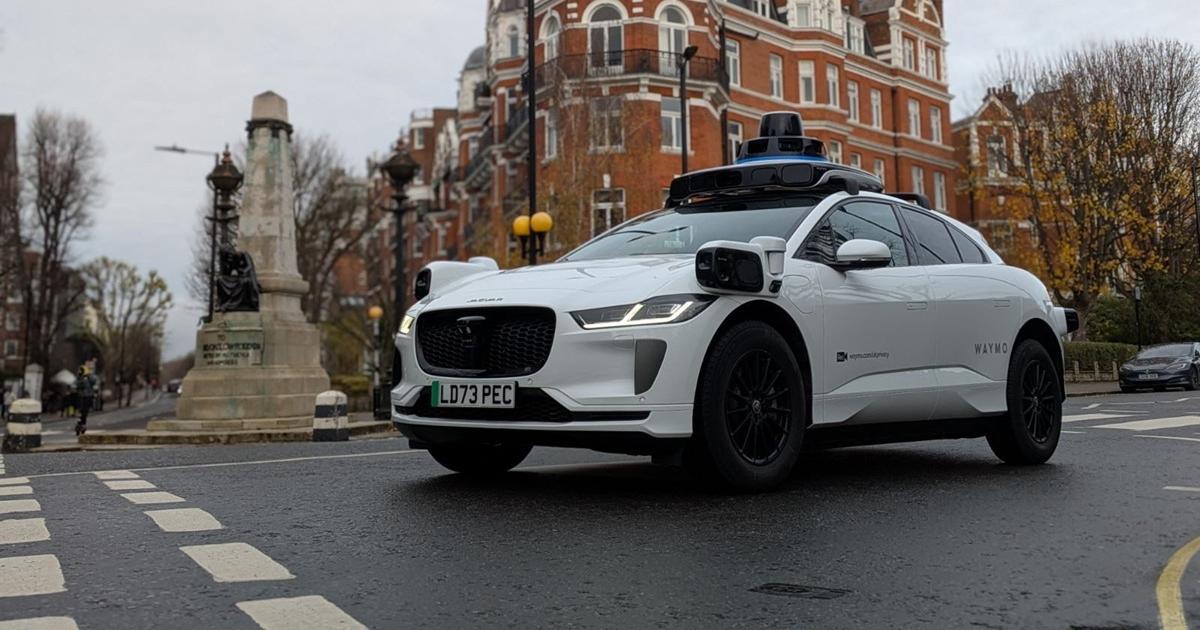
The company, a subsidiary of Google’s parent company Alphabet Inc, shared a photo on social media of one of its self-driving Jaguar I-Pace cars as it drives past the iconic Abbey Road zebra crossing.
It said: “The Waymo Driver has landed in London!
“We’re now driving in London as we prepare to bring the safety, reliability and magic of our autonomous ride-hail service to the city next year.”
The company says its software, termed the ‘Waymo Driver’, “never gets drunk, tired, or distracted.”
The cars use a combination of cameras, radar sensors, and lidar sensors – a 3D scanning technology – in its self-driving vehicles.
It says this means cars can see overlapping fields of view in all directions up to 500 metres away.
When in full service, the vehicles have no human safety driver at all.
Currently, human ‘safety drivers’ are behind the wheel as the cars are tested in the British capital.
The company currently offers passenger rides in five American cities, including San Francisco and Los Angeles, as well as Silicon Valley.
According to Waymo, testing, mapping, and ‘safety validation work’ will take place in Barking and Dagenham, Brent, Camden, Ealing, Greenwich, Hackney, Hammersmith and Fulham, Haringey, Islington, Kensington and Chelsea, Lambeth, Lewisham, Newham, Redbridge, Southwark, Tower Hamlets, Waltham Forest, Wandsworth, Westminster, and the City of London.
The self-driving cars have steering wheels on the left-hand side, as they were originally built for the company’s US operations, where traffic drives on the right.
Last week, the Department for Transport launched a call for evidence to develop a regulatory framework around self-driving technology – after a law allowing the vehicles to be used on British roads was passed last year.
The government estimates the self-driving vehicle sector could create 38,000 jobs and be worth up to £42 billion to the UK economy by 2035.