


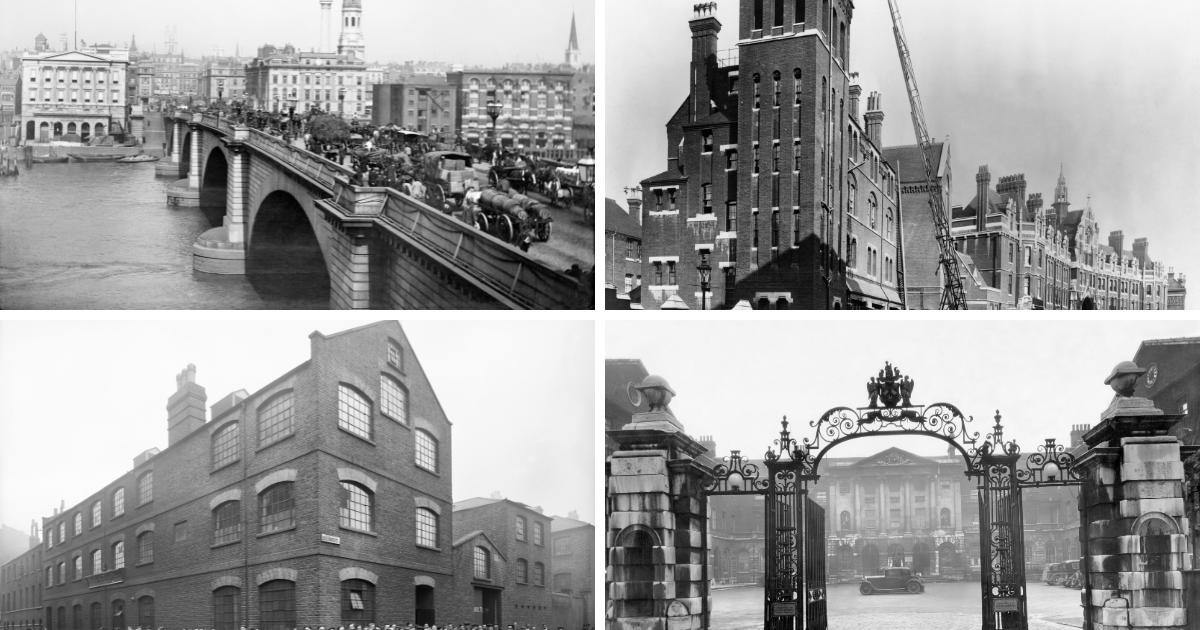
It’s no great mystery that the London landscape has changed drastically over the last 100 years, having been battered during the Blitz and later rebuilt following the end of the Second World War.
But images from Panoramas of Lost London by heritage expert Phillip Davies OBE highlight just how dramatically the capital’s streets have evolved.

The book features more than 300 black-and-white photographs documenting London’s past, capturing its people, buildings and neighbourhoods, to paint a vivid picture of how the city changed between 1870 and 1945.
From 17th-century buildings to scenes of Londoners at home, at work and at play, the collection offers a remarkable window into life in the capital.
Many of the images were taken from the former Greater London Council Historic Buildings Division, alongside material from Historic England and the Metropolitan Archives.

Southwark and London Bridge feature heavily, with a series of striking images showcasing the area, its architecture and the workers who once filled its streets.
One photo of Mabie, Todd and Company’s warehouse captures a view of workers standing outside the fountain-pen manufacturer’s premises.
The American firm established itself in England in the 1880s and thrived for decades, before production declined with the arrival of the ballpoint pen, eventually closing at the end of the 1950s.

Meanwhile another photo from Southwark Fire Station shows what the grand Gothic buildings looked like in 1908.
Police, fire and ambulance stations of the era were designed to express civic pride, and Southwark’s was among the most impressive buildings.
One photo of Tower Bridge under construction captures a view of the iron frame and upper walkway rising from the enormous stone piers sunk into the Thames.
The river crossing had been proposed as early as 1879 and was authorised by Parliament in 1885.
Designed by Sir Horace Jones and John Wolfe Barry, the bascule bridge allowed tall ships to reach the Pool of London, and after opening in 1894 it quickly became one of London’s most recognisable landmarks.
Another photo from London Bridge in around 1880 shows what the busy crossing looked like as heavily laden carts trundled over Rennie’s five-arched stone bridge.
The bridge replaced the medieval bridge that had become dangerously congested, with its predecessor opening in 1831 before it was deconstructed in 1968.
One photo of London Bridge around 1900 captures a view from the south-west towards the Church of St Magnus the Martyr, with the Monument visible behind and Fishmongers’ Hall to the left.
Finally, another photo from Guy’s Hospital in 1934 shows what the grand entrance looked like that year.