


Unlock the Editor’s Digest for free
Roula Khalaf, Editor of the FT, selects her favourite stories in this weekly newsletter.
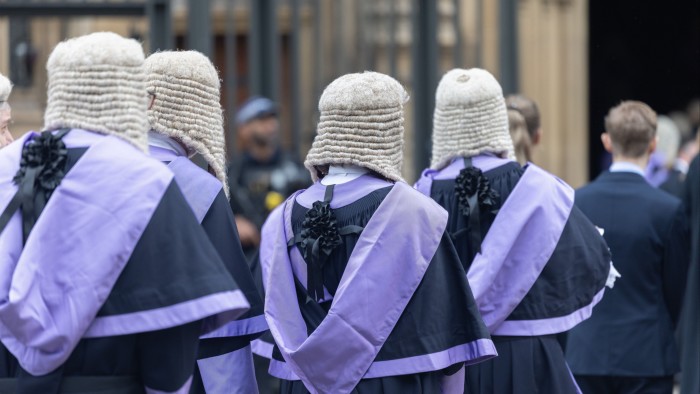
Plans to curb jury trials in England and Wales threaten to expose judges to intimidation, the chair of the Criminal Bar Association has warned, as the government prepares to announce the biggest transformation of the court system in a generation.
Ministers are examining contentious proposals to end jury trials for a broad range of offences and establish a new, lower tier of juryless courts. Justice secretary David Lammy is expected to unveil the reforms early this week.
Riel Karmy-Jones KC, chair of the CBA, said the risk of judges being threatened was one of many problems with the mooted overhaul, under which verdicts in more serious criminal cases would be delivered by a judge instead of a jury.
“It’s easier to intimidate one person than it is to intimidate 12,” she said in an interview. “It’s easier to identify one person than it is to identify 12.”
“There could be risks if there’s a lot at stake” for defendants, Karmy-Jones said. She cited trials involving criminal gangs in which the defendants are facing life sentences if found guilty, as well as fraud cases, which “may well have money behind them”.
Lammy’s proposed overhaul of the court system is an effort to address lengthy delays to cases stemming in large part from a lack of investment.
Almost 80,000 cases are waiting to be heard in the Crown Court, a backlog that has doubled since 2019. A quarter of all Crown Court cases wait a year or more to be heard and some trial dates are listed as late as 2030.
A leaked government memo from Lammy said juries should be scrapped for cases likely to result in a prison sentence of five years or less.
Judges alone would also determine guilt in cases involving fraud and financial offences, if the judge “considers the case to be suitably technical and lengthy”, according to the memo.
The proposals went beyond a government-commissioned review by Sir Brian Leveson, who suggested limiting jury trials to cases with expected sentences of three years or more.
The Financial Times reported last week that the final reforms are likely to be less far-reaching than Lammy set out and closer to those proposed by the Leveson review.
Karmy-Jones said the criminal bar had been “really quite taken aback” by the “knee-jerk” Lammy proposals. But she said the bar was “pretty roundly against” several of the proposals from Leveson, who also set out plans for an “intermediate” tier of court.
“There is a fundamental right to be tried by a jury — it’s a principle we have had for hundreds of years,” she said. “A jury trial provides a check and a balance on what may be sometimes absurd decisions of the state.”
Karmy-Jones said she was not particularly concerned about a risk of bribery or corruption in judge-only trials, saying the judiciary in England and Wales had “great integrity”.
However, she pointed to the risk of bias, and said judges could be “case hardened”.
“There is a suggestion that juries don’t understand fraud trials, for example, but that is certainly not our experience . . . To say that they won’t understand these cases is utterly patronising.”
Reports of intimidation of juries and judges are rare in the UK, although several judges were murdered in Northern Ireland during the Troubles. The judiciary is concerned, however, about increased online abuse and physical attacks.
Rolling back jury trials would “change the equation”, Karmy-Jones said. “Judges might well find that they have to have security measures in place to protect them going to and from court.”
“Judges would have to write their judgments, which would be public, and as individuals they are more exposed to threat as a result,” she added.
The Ministry of Justice said in a statement: “No final decision has been taken by government. We have been clear there is a crisis in the courts, causing pain and anguish to victims — with 78,000 cases in the backlog and rising — which will require bold action to put right.”