


The 1986 neo-noir crime drama Mona Lisa portrays the area around King’s Cross station, in London, as a squalid, hellish realm of prostitutes and drug lords, a landscape of vice and exploitation. It could have been the story of at least half a dozen mainline train stations in major urban hubs across the world at the time. It was not a place you would want to buy a home.
Little changed in the next decade or so. When Nicky Fuller bought a two-bedroom flat in a converted warehouse in Ice Wharf, on the station’s doorstep, in 1999, it was still the world “depicted in some of the 1970s and 1980s films: rundown and seedy”, she says. But it was “brilliantly central with a great transport hub”.
Yet hers was eventually to prove a canny buy. From 2008, Fuller watched as a 25-year project unfolded minutes from her door, a £3bn urban regeneration programme that would widely come to be considered one of the world’s most successful, and which would — alongside upgraded national and international transport links — transform an industrial, no-go area into a vibrant, mixed-use district with a raft of residential developments (often imaginatively converted from former industrial sites), commercial spaces attracting blue-chip residents such as Google and Meta, groundbreaking cultural venues, hot-ticket restaurants — and an internationally renowned arts and design college.
“It has been exciting to watch the metamorphosis,” says Fuller. Her apartment has quadrupled in value, outperforming wider London, where average flat and maisonette prices tripled (up 209 per cent) between December 2000 and October 2025, according to Land Registry Data.
The King’s Cross success story has not gone unnoticed by urban planners around the world. From Madrid to New York, new planning, zoning and building regulations are opening up the possibilities for living around major transport hubs. The time is ripe; across the globe, significant investment is being promised to upgrade travel by rail — UK chancellor Rachel Reeves recently announced a “transformative” upgrade of northern England’s rail system over the next two decades. Central to this concept is Transit-Oriented Development (TOD), an urban planning strategy that creates dense, mixed-use, walkable neighbourhoods around high-quality public transport.
Living near a “nice” major mainline train station can lift the value of a property by as much as 9.6 per cent, says Lindiwe Rennert, senior research associate at the Urban Institute, a social science think-tank in Washington DC. Conversely, living near a “bad” transit hub can have a depreciating factor of 7.4 per cent. (Living near simple light rail offers less uplift compared to a mega commuter station, Rennert says.)
As major stations on every continent grow in might, with faster connections to other national and international hubs, homeowners have the potential to benefit, if there’s a halo effect. But as illustrated by the disruption, delays and accusations of wasteful spending around London’s Euston station, or the difficulties and scepticism over New York’s Penn station’s renovation, it’s not a slam dunk. The question for developers and urban planners is, how do you turn a transitory place into a destination in its own right?

The question is also pertinent in the UK on a local level; the government recently announced an era of rapid residential building next to train stations to “drive densification”, part of its goal of building 1.5mn homes in England. An announcement late last year gives developers “a default yes” to build homes which meet certain criteria within 800 metres of the busiest two-thirds of railway stations in England.
“Consistent placemaking, transforming the whole area, is key to driving uplift,” says Emily Williams, a director in Savills residential research team in the UK. Property close to new and refurbished stations in the UK outperforms the wider market by 10-15 per cent, from the point of opening, according to the agency’s research. She caveats: “If the area around the transit doesn’t feel great or welcoming, it will score lower, even if it is well-connected. The thing that drags somewhere down is the immediate surroundings and perceived quality of place.”
King’s Cross was once a rural escape for the genteel middle class, but its reputation took a turn for the worse after the Regent’s Canal was built in 1820. The wealthy moved away as the neighbourhood became an industrial stronghold. Low-quality housing for workers went up, along with overcrowding and crime. A statue of King George IV erected in 1830 did little to improve the area’s tarnished image; it was torn down 12 years later (the name King’s Cross stuck, however).

Developer Argent (now Related Argent), had a better plan than a statue. It started construction on the King’s Cross master plan in 2008, a project closely linked to the 2012 London Olympics. It began with regenerating the surrounding land and restoring the station’s Victorian features, integrating them with modern infrastructure including a diagrid roof. Eurostar moved from Waterloo to the newly refurbished, immediately adjacent St Pancras International.
The 67-acre regeneration extended beyond the station. A new home was built for the prestigious Central Saint Martins art school in 2011, as well as an 8,000 sq m public space with dancing fountains and terraced canalside seating, dubbed Granary Square, in 2012. Twenty-six acres of open space were added, 400 mature trees planted and about 1,750 homes. About 372,000 sq metres of new office space attracted a cluster of high-profile tech tenants including Google, Meta and GSK’s AI hub.
Far from its industrial beginnings under the Victorian railway arches, Coal Drops Yard became a pedestrianised shopping and restaurant destination re-envisioned by Heatherwick Studio. Today, some 47,000 visitors descend on the site on an average weekend to browse Paul Smith, Margaret Howell and Aesop, as well as hipster newcomers such as soul record store Honest Jon’s. Mexican restaurant El Pastor serves an excellent margarita, says Fuller. King’s Cross Academy, a primary school for 420 pupils with a 26-place nursery, was added in the Plimsoll Building next to the Gasholders structure, underlining its identity as a family-friendly neighbourhood.

King’s Cross’s new residential developments, including Gasholders, Tapestry Apartments and Cadence Court, all “traded well initially, above the local average; resales of units in Tapestry Apartments have seen a 12-15 per cent price increase, and those in Gasholders achieved a 13 per cent uplift, only 18 months from initial sale,” says Oliver Sanhaji at property consultant Middleton Advisors. “This is something that not many new-build owners in London can claim.” The King’s Cross average is £1,100 per sq ft, he adds; prime central London in general averages around £1,300-£1,450, according to 2025 data from Investec and LonRes.
“Make it light, bright and green and as joyous as possible,” advises Rennert of holistic station regenerations, with uplifting areas for walking and browsing, with shops, cafés and nature. The most successful create a “non-chaotic” feel.
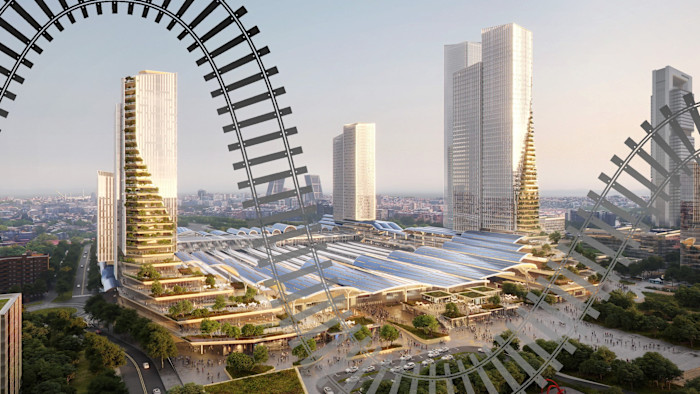
Madrid Nuevo Norte is a skyline-defining train station renewal project which began in 2022, set to be Europe’s largest. Spanning 2.3mn sq m, it will dwarf King’s Cross — and include almost 10,500 homes. Thirty-eight per cent of them will be “affordable”, with 20 per cent allocated to social housing and 18 per cent under the control of Madrid city council.


An expanded Chamartín-Clara Campoamor station is the cornerstone, with high-speed links to Barcelona, Valencia and Seville, along with connections to the underground, commuter trains and buses. A 200,000 sq m Central Park will be built over the railway tracks, connecting the former hunting grounds of El Pardo to the north with El Retiro park downtown. Cycle lanes will integrate the district with the rest of the city and 1.6mn sq m of new office space.
The first 741 residences of the 25-year project break ground next year, surrounded by nine green spaces, a multi-sports court and outdoor workout areas, a children’s play area and a dog park. “The goal is to create a ‘15-minute city’ where the workplace, residence and essential services are all within a short walk or transit ride,” says Mariola Merino, director of design, innovation and sustainability at Crea Madrid Nuevo Norte.
For people who live nearby, despite the disruption from the construction, it has the potential to be life changing, says agent Marco Gramaglia of Dils Lucas Fox in Spain. Hope is riding high: he adds that since the approvals for residential development were granted last year, there has been a 17.7 per cent uplift in property prices in the Chamartín area, 5 per cent of which he estimates is due to the station regeneration. The area’s price rises are in line with Madrid more broadly between December 2024 and December 2025, according to data from agency Idealista. Caveats Gramaglia: “We are still in pretty early phases of the development, so we haven’t reached the peak of what this could look like.”

In New York, new zoning rules are opening up the areas around major stations including Grand Central Terminal. Straddling several blocks around 42nd Street and Park Avenue, with its soaring ceilings, murals and marble, Grand Central is a symbol of America’s Gilded Age, when Midtown East was the stamping ground of the Astors, the Vanderbilts and other elite families. Its neighbours are among New York’s most famous institutions, including the New York Public Library, the Chrysler Building and the Morgan Library. And yet, it’s not considered a “hang-out” by many New Yorkers, who say it can feel corporate or lacking buzz, without the family feel that comes from the cycle paths, pocket parks and playgrounds that other mixed-use areas have adopted.
But residents say the vibe is starting to change. On East 44th, French interior designer Maud Ferrand has been renting a 900 sq ft apartment in the Beaux Arts building for the past two years. She previously dismissed the area as “too impersonal, a tourist neighbourhood and a business district”, but it has improved, she says. “The area around Grand Central is evolving into a luxury hub, central without feeling chaotic, prestigious without being flashy and timeless rather than trendy.”


Much of this is down to the Midtown East rezoning, an area of 73 blocks surrounding Grand Central, which now allows increased development rights in exchange for contributions to a District Improvement Fund to improve the pedestrian and transit areas and help restore the station’s ageing infrastructure. New rules allow for more office-to-residential conversions, which has rippled into real estate values; prices per square foot in Midtown East rose 17.6 per cent between November 2024 and November 2025; wider Manhattan was down 0.36 per cent, according to Redfin. Developer Navigation Capital Group acquired a site for its first New York residential project: Monogram, a block of 191 studio, one and two-bedroom condominiums with views of the United Nations Headquarters. Studios have all sold; one-beds start at $1.19mn.
“The Midtown East area has been reawakening,” says Patrick Zhu, the group’s president and chief executive. The proximity of new residential spaces “to such a diverse transit hub . . . is a valuable attribute for which premiums can be applied. It differs considerably from other major transit-oriented neighbourhoods in the city.”
A seven-minute walk from Grand Central, at 301 Park Avenue, the historic Waldorf Astoria hotel reopened last year after a $2bn renovation, with the addition of 372 condominiums above the hotel. As of this month, more than $200mn in sales had been closed. A studio starting price is $1.88mn.
A station-linked rezoning called Pacific Park (formerly Atlantic Yards) has also begun transforming Downtown Brooklyn, centred around the new Atlantic Avenue-Barclays Center. Although improved links via the Long Island Railroad Station (LIRR) had long expanded connectivity in Downtown Brooklyn (as far as Montauk in the Hamptons), previous zoning had prevented the development of new housing in the immediate vicinity.


But in May 2025, the Atlantic Avenue Mixed Use plan was approved, covering 13 blocks of Atlantic Avenue and neighbouring Crown Heights and Bedford-Stuyvesant. The plan will focus on affordable housing and economic development — as well as amenities for local residents. Just shy of $25mn will be invested in St Andrew’s playground, including a new field with a running track and other green infrastructure. With the rezoning, developers of upscale condos are piling in.
One such is Urban Development Partners, the company behind The Bowen, a 13-storey condo near the intersection of Boerum Hill, Cobble Hill and Carroll Gardens. “The connectivity is at the forefront of why people are buying here. You can get to the Hamptons on a Friday night in the middle of summer in under two hours,” says Greg Williamson of Douglas Elliman Development Marketing, who grew up in the area.
“When I was a kid, you would never have thought of Downtown as a place to live. Now that New Yorkers are spending more time out of the city, it is location, location, location.” Proximity to a mainline station is becoming key.

In Europe, engine room projects around stations include those under way in Berlin; Europacity is a 90-hectare site adjacent to Berlin Central Station being developed by Austria’s CA IMMO, among others. While construction is ongoing, Europacity is already being hailed a success in turning a disused brownfield site into a vibrant urban area with skyline-changing architecture, such as The Cube, a striking, kaleidoscopic, energy-efficient office block.
But sometimes ideas for urban regeneration can get ahead of themselves. In Denmark’s second-largest city, Aarhus Central Station is in the midst of major reworking. The original master plan envisioned by CF Møller Architects described a “visionary”, mixed-use “green oasis” built directly over the existing railway tracks. Plans were shelved to focus on the electrification of the tracks and high-speed rail service between Aarhus and Aalborg, which is expected to complete by the end of this year. Price growth in the area over the past 12 months was the fastest outside of Copenhagen.
There remain plenty of mainline stations whose neglect is a cautionary tale. Just a short distance from King’s Cross, Euston station has been described by critics as “panic-inducing”. The redevelopment of London’s oldest intercity station was paused after the UK government announced that the high-speed rail network HS2 would be delayed. Euston remains a construction site with hoardings and work still happening on the tunnels, despite the hiatus.


“Values in the Euston area dropped 11 per cent over 2025 compared with 2024, probably related to the ongoing building work and poor access around the station,” says Richard Donnell, executive director of research at Zoopla. Property prices in the neighbouring areas of Marylebone and Bloomsbury fell just 2 per cent in the same period, he adds. But he posits that as a result, “Euston is more of a buying opportunity ahead of completion of the works as values have underperformed more than the other areas over the past decade. Neighbourhoods evolve and change and that is what is happening in Euston.” Nicky Fuller’s King’s Cross experience is perhaps a case in point.
House & Home Unlocked

Don’t miss our weekly newsletter, an inspiring, informative edit of the news and trends in global property, interiors, architecture and gardens. Sign up here.
And regeneration must call for a more holistic view than just the transport links, emphasises Rennert. The 115-year-old Penn station in Manhattan has long struggled with its reputation for “crumbling infrastructure, bleak and dirty architecture, unnavigable hallways, and no inviting spaces for families with kids”, according to US transportation secretary Sean P Duffy. Governor Kathy Hochul compared the surrounding area to “skid row”.
Long overdue construction on a station transformation led by the US Department of Transportation and national railroad company Amtrak is scheduled to start in late 2027. Plans for nearby residential development have divided locals, but last August, the Midtown South Mixed-Use Plan, a rezoning centred around Penn station, was approved. It is expected to yield around 9,500 new housing units, with just under a third permanently affordable.
Station revitalisation isn’t just about shorter commutes, but offers the potential to radically change cities for the better. And making life “as joyous as possible”, in Rennert’s words, is always a good place to start.
Find out about our latest stories first — follow @ft_houseandhome on Instagram