


Unlock the Editor’s Digest for free
Roula Khalaf, Editor of the FT, selects her favourite stories in this weekly newsletter.
Germany’s parliament is set to agree to more than €50bn in military purchases on Wednesday, rounding off a bumper year as the EU’s largest nation ploughs ahead with a vast rearmament.
Members of the Bundestag’s budget committee, which has the power to block or approve all significant weapons purchases, have been asked by officials to sign off on projects including a €21bn order for clothing and protective equipment for soldiers, according to documents seen by the Financial Times.
Other contracts include a €4bn deal for Puma infantry fighting vehicles and close to €2bn for satellite systems aimed at boosting European reconnaissance capabilities on Nato’s eastern flank.
Christian Mölling, director of the Berlin-based think-tank Edina, said that the mantra of German procurement was “get whatever you can by 2029” — the year officials in Berlin believe that Russia could be ready and willing to attack Nato.
The high outlay comes as items big and small — from new uniforms to a multibillion-dollar set of Arrow 3 missile systems from Israel — have begun to reach Germany’s troops after decades of underfunding and neglect.
The EU’s largest nation spent as little as 1 per cent of GDP on defence in the 2000s and 2010s.
Russia’s full-scale invasion of Ukraine in 2022 prompted the then German chancellor Olaf Scholz to proclaim a “Zeitenwende” — a sea change — in the nation’s approach to security and defence. He unveiled a €100bn special fund for overhauling the military.
Scholz’s successor, Friedrich Merz, went further after taking office in May this year. He did away with borrowing constraints to allow unlimited spending on defence and vowed that he would make the German military the strongest conventional army in Europe.
Germany plans to spend €650bn in total on defence between 2025 and 2030 — double the budget of the preceding five years. While the budget for this year and 2026 has already been approved by parliament, the Bundestag’s budget committee must still sign off on every procurement contract worth more than €25mn, with the payments due to come out of successive budgets in the years ahead.
Berlin has made a long list of big-ticket purchases since 2022. They include a tranche of 35 US-made F-35 fighter jets that can carry American nuclear weapons stored on German soil and 20 more Eurofighter Typhoons.
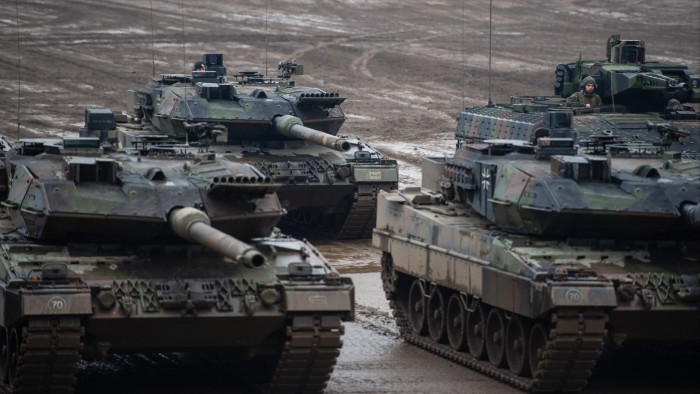
It has ordered US-made Patriot and German-made IRIS-T air defence systems, more than 100 modern Leopard 2A8 tanks, 60 Chinook heavy-lift helicopters, plus a raft of new warships and submarines and billions of euros’ worth of ammunition.
The huge number of contracts signed this year comes as defence minister Boris Pistorius has strived to dramatically speed up Germany’s notoriously sluggish defence procurement system. Parliament has been one of many bottlenecks, but officials are proud of having sped up the rate of approval from 46 projects in 2021 to 97 last year.

The spree has prompted intense debates within the defence industry, with tensions over how much equipment should be bought from US arms makers versus European ones, and how much should be spent on “conventional” weapons such as tanks rather than on novel technologies such as drones.
German procurement officials have said they are prioritising filling Nato’s capability gaps, focusing on air defence as well as offensive capabilities such as precision missiles that could strike deep into Russian territory.
“In the end I would like to defeat my enemy before he crosses my border,” senior defence ministry official Carsten Stawitzki told a conference in Berlin last month.
Stawitzki argued he was “not a dinosaur” and understood the importance of supporting innovation by buying newer technologies. But he also pushed back at those from the start-up world who say that Ukraine shows that Nato must prioritise drone warfare. “Ukraine is not a blueprint,” Stawitzki said, arguing that Kyiv had been forced to buy a high number of drones because it lacked the conventional capabilities of many Nato armies.
Frank Sauer, head of research at the Metis Institute at the Bundeswehr University Munich, said that Germany undoubtedly needed tanks, artillery pieces, infantry fighting vehicles and other “legacy” weapons.
But he added: “The question is how much do I need of each item, and what can I get in which timeframe? At the moment I would definitely be putting an especially strong emphasis on everything that is cheap . . . and available.”
Sauer voiced concern about the slow pace of delivery of many traditional weapons. Germany’s first operational F35s are not expected until the second half of 2027, while its new submarines are due to be delivered in the early 2030s. The order for Leopard 2A8 tanks, which are made by KNDS and Rheinmetall, will not be complete until 2030. The country’s first P-8 Poseidon maritime patrol aircraft was delivered by Boeing in October, four years after it was ordered.
The Bundeswehr is planning to buy up to 12,000 armed drones for around €1bn with delivery to start as early as next year. But that sum represents a tiny fraction of the overall spending.
“If there is a war with Russia — and I hope it never comes to that — it will not look exactly the way it looks in Ukraine,” Sauer said. “But it will also not look the way that people in Berlin and Brussels envisage. If the Russians make us fight the way they want to fight, then we’re in deep trouble.”
Germany’s rearmament comes against the backdrop of increasing uncertainty about future US support for Europe and whether Washington will retain its 90,000 troops stationed on the continent.
Pistorius also faces challenges over recruiting enough personnel as he seeks to boost the size of the professional army from around 184,000 today to 260,000 by 2035. At the same time, he is grappling with several high-profile procurement projects that have been plagued by delays and rising costs, including a €20bn project to digitalise the army’s communications and a multibillion contract to build anti-submarine frigates.